
Home loan for under-construction property: Everything You Need to Know
Planning to buy an under-construction home and wondering whether you can get a home loan or what benefits come along with it? In this blog, we explain everything about home loans for under-construction property: how it works, when you get tax benefits, what documents are needed, and how disbursement & interest work, especially if you take a home loan in India. This will help you navigate the process with clarity and confidence.
What is a home loan for under-construction property?
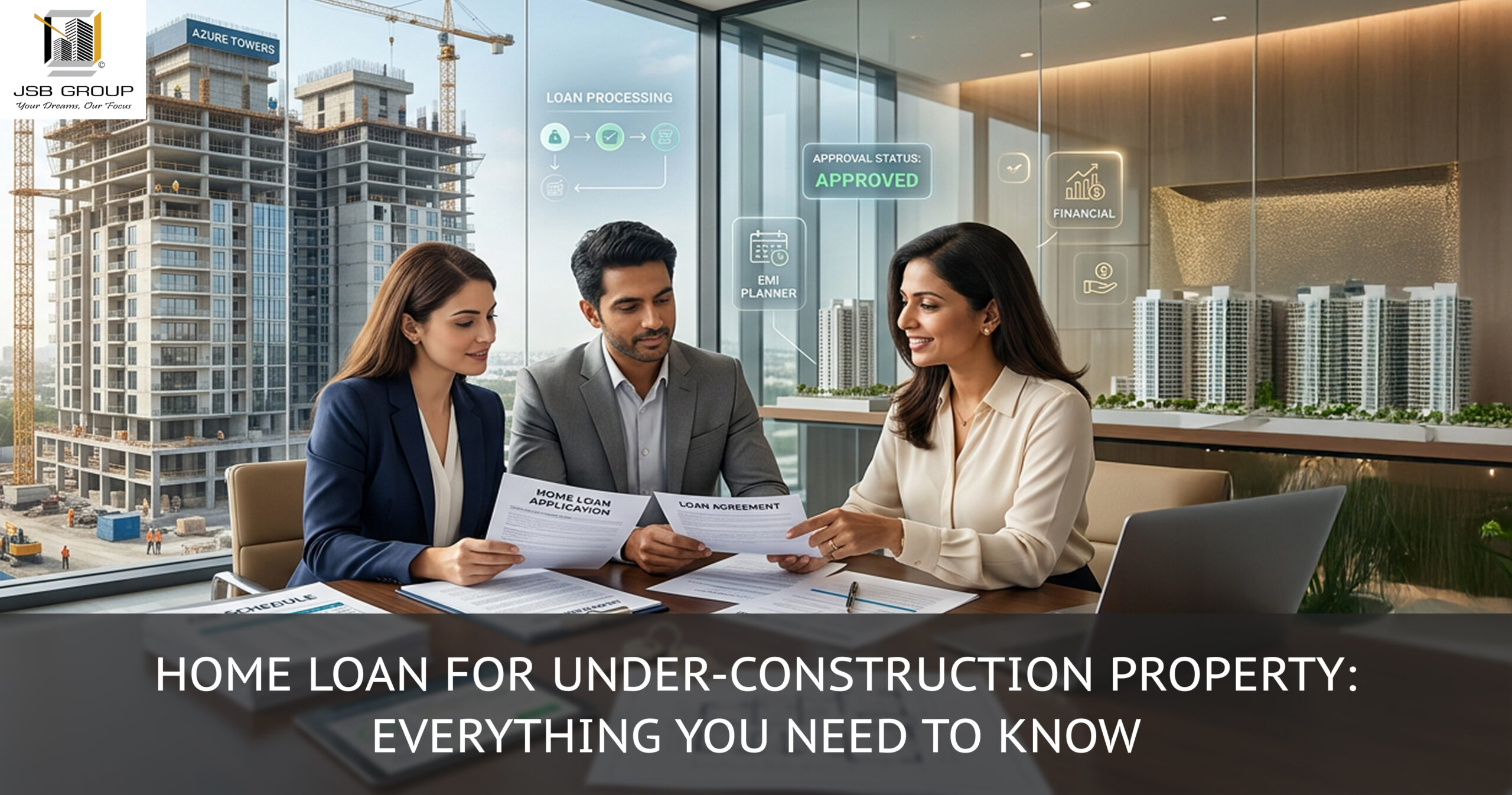
When you book an apartment or house that is still being built often sold by builders/promoters, and needs financing, you typically take what’s called a “home loan for under-construction property”. Instead of paying the full price upfront, the bank or housing finance company disburses the loan in stages (tranches) linked to the construction progress. Once the structure completes (or reaches specified milestones), the loan amount is disbursed to the builder. Meanwhile, you may or may not start paying EMIs; often, you pay only the interest on the disbursed amount,, known as “pre-EMI.”
This approach lowers upfront burden for the buyer and aligns payment with construction progress, a popular financing method when buying new apartments or under-construction homes. Many developers, such as JSB Group, offer homes in various phases of construction, making such loans particularly relevant.
Home loan disbursement for under-construction property
When you apply for a home loan for an under-construction property, the lender sanctions the full loan amount, but disbursement happens in phases. As construction progresses e.g., completion of foundation, slab, floors, roof the bank releases funds in tranches to the builder.
Meanwhile:
- You may pay only the interest on the disbursed portion (pre-EMI), not full EMIs (since principal repayment begins later).
- Once the full loan is disbursed and the property is ready for possession, regular EMI (principal + interest) repayment begins.
- This phased disbursement reduces initial financial burden and helps align payments with construction which can take several months or years.
What Documents required for home loan for under-construction property
When applying for such a loan, lenders typically ask for:
- Proof of identity (PAN card, Aadhaar, passport, etc.)
- Proof of address
- Income proof – salary slips, Form 16, bank statements, or business income statements for self-employed
- Bank statements (usually last 3-6 months)
- Loan sanction letter from the bank/housing finance company
- Agreement/booking letter with the builder/promoter for the under-construction property
- Project details/builder licence/approvals (depending on lender’s requirement)
- Post-disbursement, builder’s drawdown schedule (to release funds in phases)
Having these ready helps smooth the loan approval and disbursement process. Also, after completion and possession, you may need proof of possession or a completion certificate to claim tax benefits.
Home loan interest for under-construction property and Pre-EMI
During construction, since only part of the loan is disbursed (or none, initially), you are likely to be in “pre-EMI” mode. Pre-EMI consists only of interest on the disbursed amount; there’s no principal repayment yet.
This keeps the monthly outgo lower until the full loan is disbursed and possession is taken. Once full disbursement is done and possession achieved, regular EMIs (interest + principal) begin.
However, it’s important to note: pre-EMI interest payments during construction do not attract immediate tax deductions.
Home loan benefit for under construction property: When do tax benefits come?
Section 24(b) (Interest deduction) & Pre-construction interest
- For under-construction properties, interest paid during construction (pre-EMI or disbursed portion) is classified as pre-construction interest.
- This interest cannot be deducted immediately. Instead, once construction completes and you take possession, you can claim this pre-construction interest in five equal instalments over the next five years (starting the financial year of possession).
- For a self-occupied property, the total interest deduction (pre-construction instalment + interest paid post-possession) is capped at ₹ 2 lakh per annum under Section 24(b).
- If the construction exceeds the permitted timeframe (for example, more than 5 years from loan sanction), the deduction limit may drop (for example, to ₹ 30,000 per year) — as per tax rules.
Section 80C (Principal repayment, stamp duty, registration)
- Once you start paying principal (after possession), you can claim a deduction under Section 80C, subject to the overall limit of ₹ 1.5 lakh per year.
- Stamp duty and registration charges may also be claimed but only after possession/completion, not while under construction.
Additional benefit (when applicable): Section 80EEA
- For certain eligible first-time homebuyers, Section 80EEA allowed additional interest deduction (on top of Section 24(b)), subject to conditions like the value of the property (stamp duty value up to a certain limit) and the loan sanction date.
- However, such benefits depend on prevailing laws and conditions at the time of loan sanction; newer regulations or budget changes may modify eligibility.
In short: Tax benefits on interest and principal come only after the construction is complete and you take possession. Until then, interest paid is held as “pre-construction interest” for the future.
Key conditions & caveats to claim benefits
- Construction must be completed and possession taken for deductions to begin.
- The total interest claimed (post-possession + pre-construction instalments) for a self-occupied house is capped at ₹ 2 lakh per year under Section 24(b).
- If construction is delayed beyond the limit (often 5 years from loan sanction), deductions may be reduced (e.g., ₹ 30,000 per year) forcing caution before claiming.
- Principal repayment deduction under Section 80C and stamp duty/registration deduction only start after possession.
Keep all paperwork, interest certificates, possession/completion certificates, loan sanction letters, builder agreements, etc. to claim deductions smoothly.
Why lenders and buyers still opt for under-construction home loans
For developers like JSB Group, under-construction projects allow flexibility: you book early at a lower payment and pay gradually through loan disbursement. This makes under construction projects in Naigaon East, under construction projects in Virar West, and under construction projects in Vasai East attractive options for homebuyers looking to enter the market at competitive prices.
For developers like JSB Group, under-construction projects allow flexibility: you book early (lower payment upfront) and pay gradually through loan disbursement.
For buyers, it reduces initial cash outflow; pre-EMI interest is lower than full EMI, giving breathing room during construction.
Once the property is ready and possession is taken, you get the benefit of home ownership plus eligible tax deductions (interest and principal), making it financially efficient over the long term. It also allows planning: you lock the property early (often at a lower price) and align loan repayment with post-occupation income.
FAQ
1.Can I take a home loan on under-construction property?
Yes you definitely can. Many lenders provide home loans for under-construction properties, disbursing in stages as construction progresses. You will likely pay interest (pre-EMI) during the construction phase; once the project completes and is ready for occupation, the balance disbursement happens and regular EMIs (principal + interest) begin.
- Home loan for under-construction property
You can get a home loan with phased disbursement and pre-EMI interest until construction is completed. - Home loan deduction for under-construction property
Tax deductions start only after possession; pre-construction interest is claimable in five equal yearly parts. - Home loan interest for under-construction property
You pay pre-EMI interest on disbursed amounts during construction; full EMI starts after possession. - Home loan benefit for under-construction property
Benefits include phased payments and post-possession tax deductions on interest and principal repayment. - Home loan disbursement for under-construction property
Banks release loan amounts in stages based on construction progress, reducing upfront payment burden. - Documents required for home loan for under-construction property
You need ID, address, income proof, bank statements, builder agreement, and project approval documents. - Tax benefit on home loan for under construction property
Tax benefits apply only after completion; pre-construction interest is deductible in five annual parts. - Interest on home loan for under-construction property
Pre-EMI interest is paid during construction and becomes eligible for deduction only after possession.