

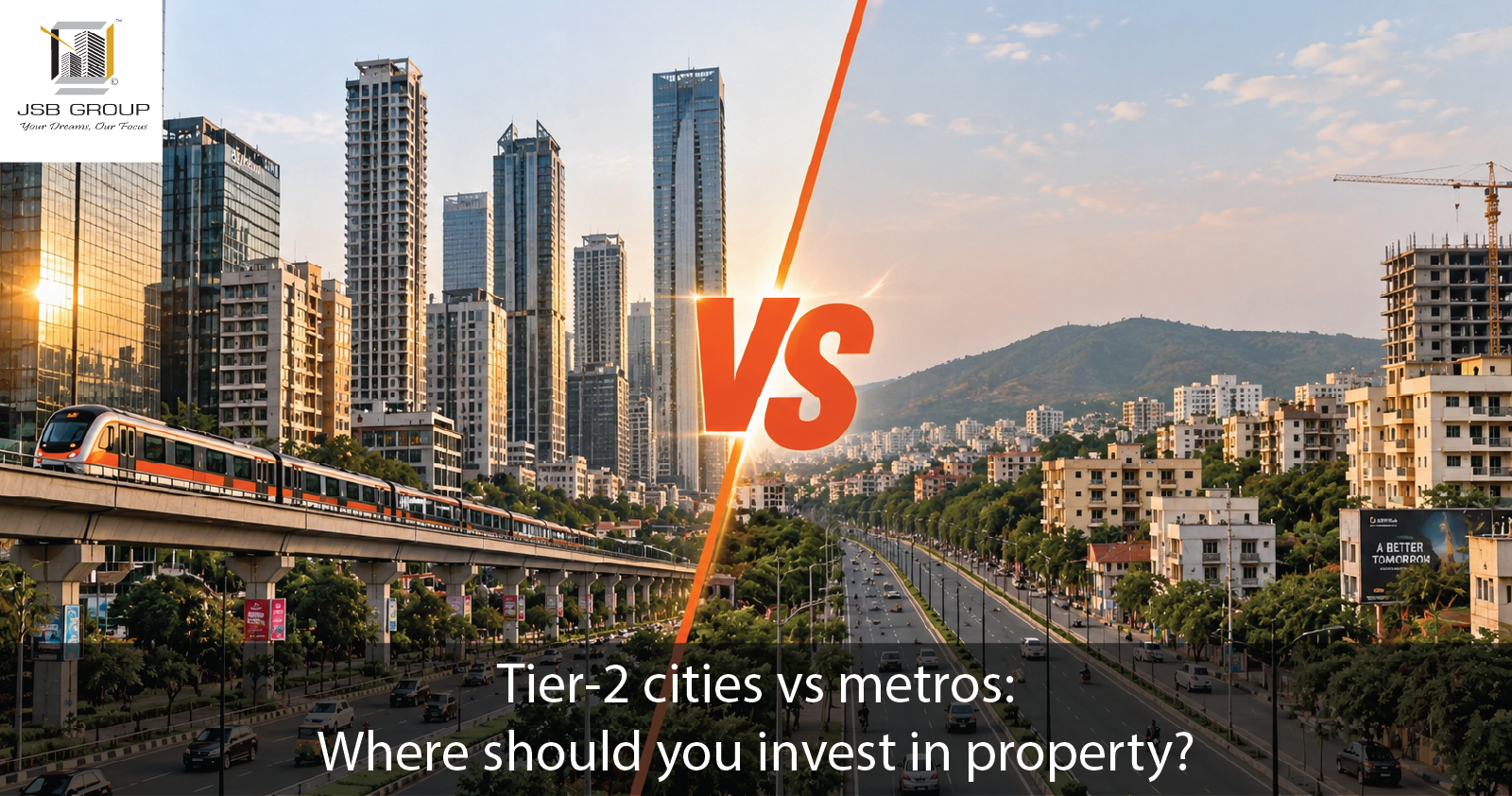
Tier-2 Cities vs Metros: Where Should You Invest in Property?
Investing in real estate is one of the most significant financial decisions you can make. While metropolitan cities like Mumbai, Delhi, Bengaluru, and Pune have traditionally attracted property investors, Tier-2 cities are increasingly gaining attention for their competitive property pricing, improving infrastructure, and long-term growth potential.
This shift has created an important question for homebuyers and investors: Tier-2 cities vs metros: where should you invest in property?
The answer depends on several factors, including your investment budget, financial goals, rental income expectations, and preferred location. Both established metropolitan markets and emerging cities offer distinct advantages, but understanding their differences can help you make a more informed investment decision.
Let’s explore how these markets compare and why developing residential destinations around Mumbai are also becoming attractive alternatives.
Understanding the Difference Between Tier-2 Cities and Metros
Metropolitan cities are major economic centres with established employment opportunities, extensive transportation networks, commercial hubs, and well-developed social infrastructure. Cities such as Mumbai, Delhi, Bengaluru, and Chennai generally experience consistent housing demand driven by employment, migration, and business activity.
Tier-2 cities, on the other hand, are smaller urban centres that are experiencing economic and infrastructural development. Cities such as Nashik, Nagpur, Indore, Jaipur, and Lucknow have attracted increasing attention from developers and investors.
These cities often offer competitive property prices, expanding residential developments, and opportunities for long-term growth.
However, investors should also consider emerging suburban markets within metropolitan regions. Locations such as Naigaon, Vasai, and Virar are part of the Mumbai Metropolitan Region (MMR), rather than independent Tier-2 cities, but they offer distinct advantages in terms of investment value and development potential.
.
1. Property Pricing: Where Can You Get Better Value?
Property pricing is one of the biggest factors influencing investment decisions.
In established metropolitan locations, high land costs and sustained housing demand often result in higher property prices. Purchasing a spacious apartment in a prime Mumbai neighbourhood can involve a substantial financial commitment.
Tier-2 cities generally provide investors with a wider range of property options at different price points. Buyers may find larger homes, modern residential communities, and lifestyle amenities that deliver stronger value for their investment.
Why Property Pricing Matters for Investors
- Competitive entry prices can create opportunities for strategic investments.
- Buyers may be able to choose larger homes within their budget.
- Well-priced properties can improve long-term investment value.
- Investors may have greater flexibility when selecting properties for long-term ownership.
For buyers who want to remain connected to Mumbai while exploring emerging residential destinations, locations such as Vasai and Virar present promising opportunities.
Developers such as JSB Group focus on residential developments across these growing locations, offering homebuyers options that balance location, lifestyle, and long-term investment value.
2. Property Appreciation: Which Market Offers Better Growth Potential?
Capital appreciation is a major consideration for anyone purchasing real estate as an investment.
Metropolitan cities benefit from established business ecosystems, developed infrastructure, and continuous residential demand. These factors can support long-term property values, especially in well-connected neighbourhoods.
However, properties in prime metro locations may already command significant premiums. As a result, future appreciation depends heavily on the purchase price, local demand, and market conditions.
Tier-2 cities may offer higher percentage growth potential in selected locations because some markets are still progressing through earlier stages of urban development.
Infrastructure expansion, employment generation, educational institutions, and commercial activity can all contribute to rising residential demand.
Factors That Influence Property Appreciation
- Development of transportation networks and highways.
- Growth of nearby employment and commercial hubs.
- Expansion of schools, hospitals, and retail facilities.
- Increasing demand from homebuyers and tenants.
- Availability of well-planned residential developments.
Property appreciation is never guaranteed. Investors should assess the actual progress of infrastructure projects, existing demand, and prevailing property prices instead of relying only on future announcements.
Within the Mumbai Metropolitan Region, the developing residential belt between Naigaon and Virar illustrates how connectivity, strategic location, and expanding neighbourhood infrastructure can influence long-term investment interest.
To understand this regional opportunity in greater detail, explore From Naigaon to Virar: Why JSB Group Projects Promise Lasting Value.
3. Rental Income: Are Metros or Tier-2 Cities Better?
Rental income is another important consideration, particularly for investors who want to generate regular cash flow.
Metropolitan cities often benefit from established rental markets supported by working professionals, students, business owners, and families relocating for employment.
Properties near railway stations, business districts, educational institutions, and commercial centres may attract consistent tenant interest.
However, high acquisition costs can affect the rental yield an investor receives.
Tier-2 cities may offer competitive rental yields in selected neighbourhoods because the relationship between property prices and rental income can be favourable. Nevertheless, tenant demand may vary significantly depending on the city’s employment opportunities and the property’s location.
What Should Rental Property Investors Evaluate?
Before purchasing a property for rental income, consider:
- Rental demand: Are working professionals and families actively searching for homes in the area?
- Connectivity: Is the property conveniently located near public transport and major roads?
- Employment opportunities: Are business centres or industrial hubs accessible?
- Rental yield: How much annual rental income can the property generate relative to its total acquisition cost?
- Maintenance expenses: What are the recurring costs of owning the property?
Both metros and Tier-2 cities can offer rental opportunities, but the quality of the individual location matters more than the city’s classification alone.
4. Infrastructure Development: A Key Driver of Property Investment
Infrastructure plays a crucial role in shaping residential real estate demand.
Metropolitan cities generally offer established transport systems, healthcare facilities, educational institutions, and commercial infrastructure.
Tier-2 cities are benefiting from investment in roads, highways, airports, industrial corridors, and urban development initiatives.
As connectivity improves, previously overlooked residential locations may become more attractive to homebuyers.
Why Investors Should Monitor Infrastructure Growth
Better infrastructure can improve accessibility, reduce commuting difficulties, and encourage the development of new residential and commercial communities.
However, investors should distinguish between completed infrastructure, projects under construction, and proposed developments.
In the Mumbai Metropolitan Region, locations such as Naigaon, Vasai, and Virar benefit from access to the Western Railway suburban network and regional road connections.
These existing transport links, together with continuing neighbourhood development, make the region relevant for homebuyers seeking connectivity to Mumbai and promising residential investment opportunities.
5. Lifestyle and Space: What Do Modern Homebuyers Prefer?
Property investment is no longer driven by location and price alone.
Modern homebuyers increasingly consider the overall living experience offered by a residential development.
Spacious layouts, ventilation, recreational facilities, security, and access to everyday conveniences can influence purchasing decisions.
In many established metropolitan neighbourhoods, limited land availability and higher property prices can restrict the range of spacious residential options.
Developing suburban locations and Tier-2 cities may offer greater opportunities for residential communities with thoughtfully planned amenities and open spaces.
The Importance of Modern Residential Communities
Homebuyers frequently look for:
- Efficiently planned apartments with practical layouts.
- Natural lighting and ventilation.
- Landscaped spaces and recreational facilities.
- Convenient access to schools, hospitals, and shopping.
- Secure and family-friendly residential environments.
JSB Group places emphasis on thoughtfully planned residential developments designed around modern lifestyle requirements.
With a presence across developing residential locations in the MMR, the brand offers homebuyers an opportunity to explore properties that combine comfortable living with accessibility and long-term ownership value.
Tier-2 Cities vs Metros: A Quick Comparison
Investment Factor | Metropolitan Cities | Tier-2 Cities |
Property Prices | Generally higher in established locations | Competitive pricing across emerging markets |
Entry Investment | Higher capital may be required | Diverse investment entry points |
Appreciation Potential | Supported by established demand | Potentially stronger in selected emerging areas |
Rental Demand | Often broader and more established | Depends heavily on local employment |
Infrastructure | Generally well-developed | Expanding in many growth corridors |
Lifestyle Options | Extensive urban conveniences | Scope for larger homes and planned communities |
Resale Market | Often deeper in established locations | Liquidity varies across cities |
Investment Risk | Can be affected by high purchase prices | Can be affected by emerging-market uncertainty |
The ideal investment depends on the individual property, its location, and your financial objectives.
6. Why Emerging Locations Near Mumbai Deserve Attention
For investors who want to benefit from Mumbai’s economic opportunities while exploring strategically located residential developments, emerging markets within the MMR are worth evaluating.
Naigaon, Vasai, and Virar offer an interesting combination of suburban connectivity, established residential communities, and ongoing development.
These locations are particularly relevant for first-time homebuyers, families seeking larger homes, and investors with long-term ownership goals.
Factors Supporting Residential Interest in Naigaon, Vasai, and Virar
Connectivity to Mumbai
Access to the Western Railway network allows residents to travel towards various employment and commercial locations across Mumbai’s western corridor.
Competitive Property Pricing
Compared with several established Mumbai neighbourhoods, these suburban markets can provide residential options with compelling value propositions.
Expanding Social Infrastructure
Schools, healthcare facilities, shopping destinations, and everyday conveniences contribute to the development of residential neighbourhoods.
Growing Housing Options
The presence of residential developments with modern amenities gives buyers more options based on their investment objectives and lifestyle preferences.
Recognising the potential of these developing locations, JSB Group has established a presence across the Naigaon–Virar residential corridor.
Its focus on strategic locations, residential planning, construction quality, and lifestyle-oriented amenities aligns with the requirements of buyers looking for long-term value.
7. How to Choose the Right Property Investment Location
Whether you are considering a metro, a Tier-2 city, or an emerging suburb, choosing the right investment requires careful evaluation.
Define Your Investment Objective
Decide whether you are buying a property for personal use, rental income, future resale, or long-term capital appreciation.
Evaluate Your Investment Budget
Calculate the total cost of ownership, including the property price, stamp duty, registration charges, applicable taxes, maintenance expenses, and potential loan interest.
Research Local Market Demand
Study property transactions, rental activity, local employment opportunities, and the availability of competing residential developments.
Verify Connectivity and Infrastructure
Focus on existing transport facilities while separately assessing the expected completion timelines of proposed developments.
Check Developer Credibility
Review the developer’s track record, construction progress, project approvals, delivery commitments, and relevant MahaRERA registration details.
Consider Long-Term Liveability
A property located in a convenient, well-maintained residential neighbourhood may remain attractive to both future buyers and tenants.
These considerations are especially important when investing in emerging markets, where the performance of individual projects can differ substantially.
So, Where Should You Invest: Tier-2 Cities or Metros?
There is no universal winner in the debate between Tier-2 cities and metropolitan property markets.
Metropolitan cities may be suitable for investors who prioritise established rental demand, access to major employment centres, and relatively mature resale markets.
Tier-2 cities may appeal to investors who want competitive property pricing, more spacious housing options, and exposure to emerging growth markets.
Meanwhile, developing suburban locations within major metropolitan regions can offer another investment route.
For buyers interested in remaining connected to Mumbai, locations such as Vasai and Virar may provide a balance between strategic location, accessibility, and long-term residential potential.
Ultimately, a well-located property purchased at a reasonable price, supported by genuine demand and a credible developer, can be a more meaningful investment than choosing a city solely because it is classified as a metro or Tier-2 market.
Conclusion
The Indian real estate market is expanding beyond traditional metropolitan centres, creating new opportunities for homebuyers and investors.
While metros continue to attract attention for their established infrastructure and employment ecosystems, Tier-2 cities offer compelling possibilities through competitive property pricing and urban development.
At the same time, emerging residential corridors within metropolitan regions are creating additional choices for buyers seeking lasting investment value.
JSB Group is contributing to this evolving residential landscape through thoughtfully planned developments in growing locations such as Naigaon, Vasai, and Virar.
For homebuyers seeking a combination of modern living, regional connectivity, and long-term investment potential, exploring the right project in these developing neighbourhoods can be a meaningful step towards property ownership.
Explore JSB Group’s residential developments and discover a home that aligns with your lifestyle, investment goals, and future aspirations
Frequently Asked Questions (FAQs)
1. Is investing in Tier-2 cities better than investing in metros?
Tier-2 cities may offer competitive property prices and growth potential in emerging markets, while metros typically provide more established infrastructure and rental demand. The right choice depends on your investment objectives, budget, and risk tolerance.
2. Are properties in Vasai and Virar good for long-term investment?
Vasai and Virar offer access to Mumbai’s suburban railway network, competitively priced residential options, and developing social infrastructure. Their investment potential depends on property pricing, location, construction quality, and future demand.
4. What matters most when choosing a property investment location?
Connectivity, employment opportunities, purchase price, rental demand, neighbourhood infrastructure, developer credibility, and long-term resale potential are among the most important considerations.
5. Why should homebuyers explore JSB Group projects?
JSB Group offers residential developments across emerging locations in the Mumbai Metropolitan Region, with a focus on thoughtful planning, modern lifestyle amenities, and connectivity. Buyers should compare individual projects according to their requirements and verify project-specific details before investing.