
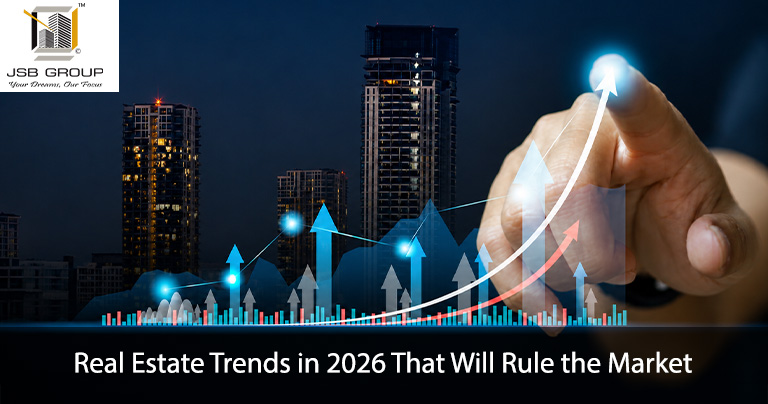
Real Estate Trends in 2026 That Will Rule the Market
The Indian real estate market is entering 2026 with a stronger focus on quality, technology, lifestyle, connectivity, and long-term value. While residential demand remains resilient, buyers are becoming more selective about where and how they invest. At the same time, developers are responding with premium homes, better amenities, sustainable features, and technology-enabled living spaces.
Residential sales across India’s major urban markets increased 8% year-on-year in Q1 2026, while premium homes priced above ₹1 crore recorded particularly strong growth. This indicates that the market is increasingly moving towards premiumisation rather than simply chasing higher sales volumes.
For homebuyers and investors, understanding these emerging trends can help identify opportunities and make better property decisions. Here are the major real estate trends in 2026 that are expected to shape the market.
1. Premium and Luxury Housing Will Continue to Grow
One of the biggest trends shaping Indian real estate in 2026 is the increasing demand for premium and luxury homes.
Homebuyers are looking beyond basic requirements such as location and carpet area. They are increasingly interested in spacious layouts, premium amenities, privacy, better construction quality, smart-home features, and lifestyle-oriented communities.
Premium housing priced above ₹1 crore accounted for 71% of residential sales across the top seven urban markets in Q1 2026, compared with 59% a year earlier.
This shift is also encouraging developers to introduce projects with stronger lifestyle offerings. For established developers such as JSB Group, the growing preference for quality-driven residential developments highlights the importance of combining well-planned homes with modern amenities and convenient connectivity.
2. Location Will Become More Important Than Ever
Location has always been a fundamental factor in real estate, but in 2026 its importance is closely linked to infrastructure and accessibility.
New metro corridors, highways, railway improvements, road networks, business districts, and social infrastructure can significantly influence property demand. Buyers are increasingly considering not just where a property is today, but how accessible it could become in the future.
Infrastructure-led development is therefore expected to remain an important real estate trend in 2026. Areas benefiting from improved connectivity can attract both end-users and investors because better accessibility can support employment growth, commercial activity, and residential demand.
For buyers evaluating a project from JSB Group or any other established developer, examining upcoming infrastructure alongside existing connectivity can provide a broader understanding of the property’s long-term potential.
3. Smart Homes Will Become a Mainstream Expectation
Technology is becoming an integral part of modern residential development.
Smart locks, video doorbells, app-controlled appliances, automated lighting, security systems, energy monitoring, and connected home devices are increasingly becoming part of the homebuyer’s expectations.
The concept of a smart home is also evolving. Buyers are no longer looking only for individual gadgets. They want integrated technology that improves convenience, security, energy efficiency, and everyday living.
As technology becomes more accessible, smart-home features are likely to move from being premium additions to becoming standard expectations in many new residential projects.
4. Sustainable Real Estate Will Gain Greater Importance
Sustainability is another major trend that will influence real estate development in 2026.
Homebuyers are increasingly conscious of energy consumption, water management, green spaces, natural ventilation, waste management, and the environmental impact of buildings. Developers are consequently exploring more sustainable construction and community-planning approaches.
Sustainable features can include:
- Energy-efficient lighting and appliances
- Rainwater harvesting
- Solar energy solutions
- Water recycling systems
- Landscaped green spaces
- Efficient waste management
- Natural lighting and ventilation
- Environment-conscious construction materials
Sustainability is increasingly being viewed not only as an environmental responsibility but also as a long-term value proposition for residents.
5. Lifestyle Amenities Will Drive Buying Decisions
The modern homebuyer is increasingly purchasing a lifestyle rather than just a residential unit.
Residential projects are therefore evolving into complete lifestyle communities with amenities designed around fitness, recreation, wellness, social interaction, and convenience.
Depending on the project, buyers may look for:
- Fitness centres
- Swimming pools
- Clubhouses
- Children’s play areas
- Landscaped gardens
- Indoor and outdoor sports facilities
- Co-working spaces
- Wellness zones
- Community areas
Industry commentary in 2026 also highlights a shift toward experience-led residential communities, where buyers value lifestyle ecosystems and green spaces alongside the home itself.
This trend is particularly relevant for families who want their residential community to support multiple aspects of everyday life.
6. Spacious Homes Will Remain in Demand
The definition of a desirable home has changed significantly over the past few years.
Buyers increasingly want homes that provide flexibility for working, studying, relaxing, entertaining, and spending time with family. This has strengthened interest in larger configurations, functional layouts, balconies, open spaces, and better room planning.
The demand for premium homes is partly being driven by buyers’ preference for larger living environments and improved lifestyle features.
7. Branded and Organised Developers Will Gain Buyer Trust
Trust will remain a critical factor in property buying decisions.
Real estate involves a significant financial commitment, making developer reputation, construction quality, transparency, project execution, and delivery track record increasingly important to buyers.
The market is also becoming more organised. Recent industry data indicates that established developers are gaining market share as buyers place greater emphasis on credibility, transparency, and execution capabilities.
This creates an advantage for established names such as JSB Group, where brand recognition and project credibility can play an important role in building buyer confidence.
For homebuyers, evaluating the developer should be just as important as evaluating the property itself.
8. Infrastructure-Led Investment Will Shape Emerging Locations
The next wave of real estate growth is expected to extend beyond established neighbourhoods into areas benefiting from major infrastructure development.
New transportation networks and commercial hubs can create new residential demand by improving accessibility and shortening travel times.
Investors are therefore increasingly looking at future infrastructure plans rather than relying solely on current property prices.
However, infrastructure announcements should always be evaluated carefully. Buyers should consider the project’s actual stage, expected completion timelines, surrounding development, and existing connectivity before making an investment decision.
9. Wellness and Green Living Will Become Key Selling Points
Wellness is becoming an important part of modern residential design.
Homebuyers are increasingly interested in environments that offer access to greenery, open spaces, walking areas, fitness facilities, natural light, and quieter surroundings.
This represents a broader change in the definition of luxury. Luxury is no longer limited to large homes or expensive finishes. Increasingly, buyers value privacy, wellness, thoughtful design, sustainability, and quality of life.
Residential developers that successfully integrate these elements into their projects can create stronger lifestyle propositions for today’s buyers.
10. Rental and Alternative Living Segments Will Expand
The real estate market is also becoming more diversified beyond traditional homeownership.
Rental housing, co-living, student housing, senior living, and workforce accommodation are expected to gain greater attention as urbanisation and changing demographics influence housing requirements.
CBRE’s 2026 residential outlook identifies institutional rental housing as an emerging growth area, particularly across student housing, co-living, senior living, and industrial workforce accommodation.
This could create new opportunities for investors and developers willing to explore specialised residential segments.
What Do These Real Estate Trends Mean for Homebuyers?
The real estate trends in 2026 indicate that buyers are becoming more informed and value-conscious. Instead of focusing only on price and location, they are evaluating the complete proposition offered by a property.
Before purchasing a home, buyers should consider:
- Developer credibility – Research the developer’s reputation and project delivery record.
- Location and connectivity – Assess both existing and planned infrastructure.
- Construction quality – Understand the specifications and materials being used.
- Amenities – Determine whether the amenities genuinely add value to everyday life.
- Sustainability – Look for features that can improve resource efficiency.
- Technology – Evaluate smart-home and security features.
- Future potential – Consider employment, infrastructure, and development prospects around the property.
- Total cost of ownership – Look beyond the property’s headline price and consider maintenance and other associated expenses.
Why 2026 Could Be an Important Year for Real Estate
The Indian real estate market in 2026 is not simply about increasing property prices or launching more projects. It is increasingly about quality, credibility, experience, connectivity, and long-term value.
Market research indicates that premium housing continues to outperform several lower-priced segments, while infrastructure improvements, urbanisation, rising incomes, and changing lifestyle preferences are supporting residential demand.
For developers such as JSB Group, these changes create an opportunity to develop homes that respond to the evolving expectations of modern buyers. For buyers, the trends highlight the importance of looking beyond short-term considerations and choosing properties that can remain relevant as lifestyles and neighbourhoods evolve.
Conclusion
The real estate trends in 2026 reflect a market that is becoming more sophisticated and experience-driven. Premium homes, smart technology, sustainability, wellness, infrastructure, and trusted developers are likely to remain key factors influencing purchasing decisions.
For buyers, the focus should be on finding a property that combines location, quality, lifestyle, connectivity, and long-term value. As the market continues to evolve, developers such as JSB Group can play an important role in meeting these changing expectations through thoughtfully planned residential developments.
Frequently Asked Questions
What are the major real estate trends in 2026?
The major trends include premium housing, smart homes, sustainable development, lifestyle amenities, infrastructure-led growth, spacious homes, wellness-focused communities, and increasing preference for organised and trusted developers.
Is premium housing a major trend in 2026?
Yes. Premium housing has been one of the strongest segments of India’s residential market in 2026. JLL reported significant growth in sales and launches in the ₹1 crore-plus segment during Q1 2026.
Are smart homes becoming more popular in 2026?
Yes. Homebuyers are increasingly interested in integrated technology such as smart security, automated lighting, connected appliances, and energy-management systems.
Why is infrastructure important for real estate investment?
Improved infrastructure can increase accessibility, reduce travel times, attract commercial activity, and support residential demand. However, buyers should evaluate the actual status and timeline of proposed infrastructure before investing.
Will sustainable homes become more popular?
Yes. Energy efficiency, water conservation, green spaces, natural ventilation, and sustainable construction are becoming increasingly important considerations for developers and homebuyers.
Why should buyers consider the developer’s reputation?
A developer’s reputation can provide valuable insight into project execution, construction quality, transparency, and delivery capabilities. In a market where buyers are becoming more selective, established developers such as JSB Group can benefit from stronger brand recognition and buyer trust.
What should homebuyers look for when buying property in 2026?
Homebuyers should evaluate location, connectivity, developer credibility, construction quality, amenities, sustainability, technology, legal documentation, total acquisition cost, and the property’s long-term potential.